
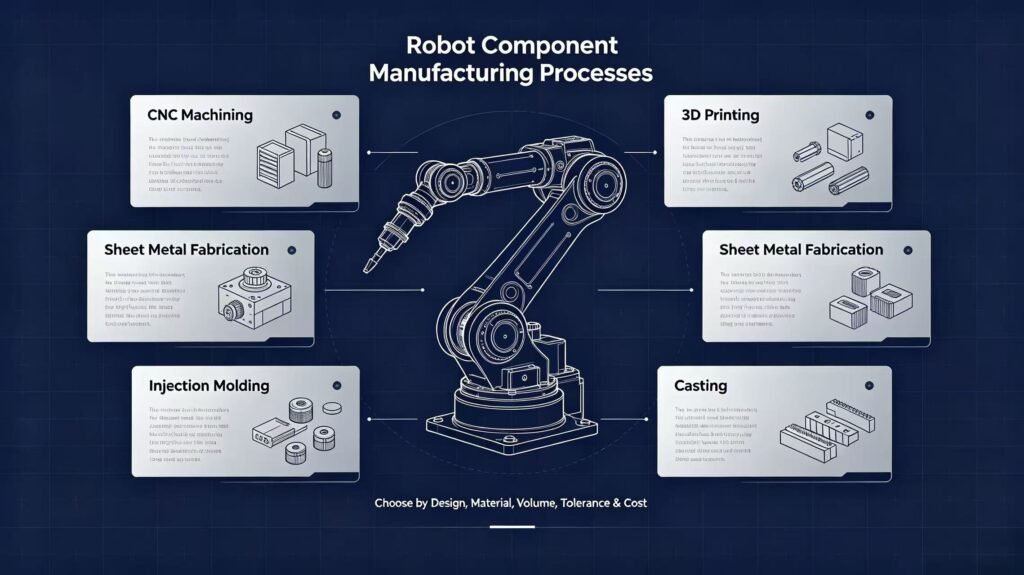
Robotics and automation equipment require components with high precision, strength, andconsistent quality. But which manufacturing process is right for your robot parts?
The answer depends on the part design, material, quantity, tolerance, and application.
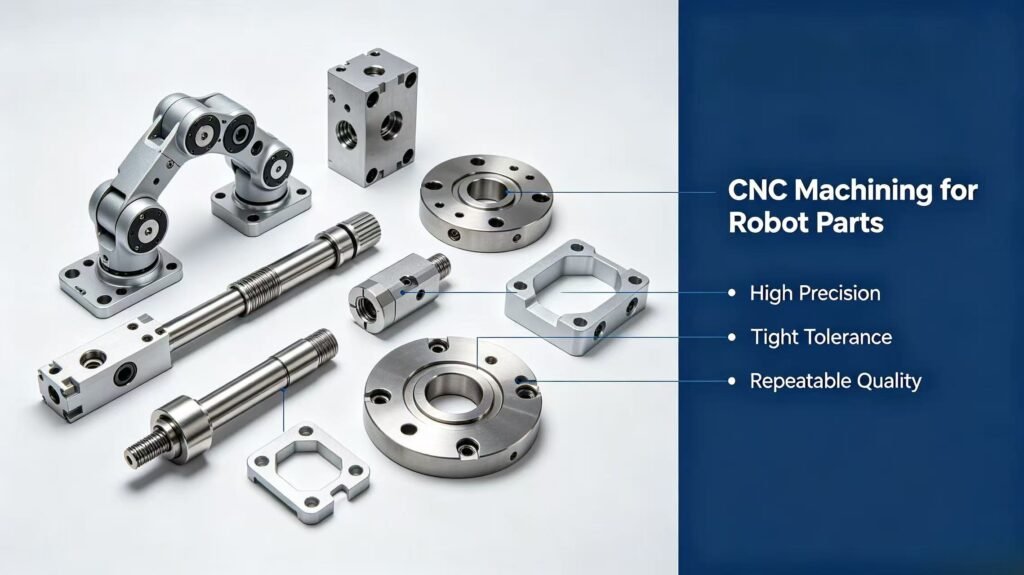
CNC Machining for Precision Robot Parts
CNC machining is widely used for precision robotic components such as robotic arm parts,brackets, shafts, housings, and end-effectors.
It offers excellent dimensional accuracy, repeatability, and surface finish. Materials such asaluminum, stainless steel, brass, copper, and engineering plastics can be CNC machined.
For low- and medium-volume custom robot parts, CNC machining is often an efficient solution.
3D Printing for Robot Prototypes
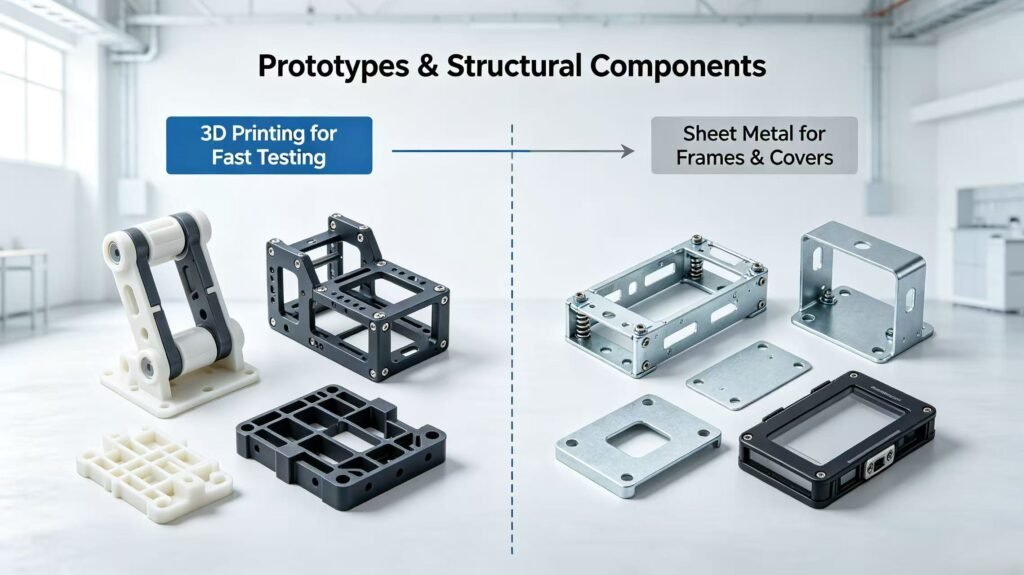
3D printing is ideal for prototypes, complex structures, and customized low-volume components.
It allows engineers to test new designs quickly without expensive tooling. Once the design is finalized, the part can be transferred to CNC machining or injection molding for production.
Sheet Metal Fabrication for Robot Structures
Sheet metal fabrication is commonly used for robot frames, mounting brackets, protective covers, panels, and automation equipment enclosures.
Laser cutting, bending, and welding can be combined to produce customized sheet metal robot components according to 2D drawings or 3D CAD files.
Injection Molding for High-Volume Plastic Parts
For large quantities of plastic robot components, injection molding can provide consistent quality and efficient production.
It is suitable for robot housings, covers, sensor components, plastic brackets, and cable management parts.
Although tooling requires an initial investment, injection molding can reduce the unit cost when production volume increases.
Casting for Complex Metal Components
Casting is suitable for certain complex metal robot components and larger production requirements.
For parts requiring higher precision, casting can be combined with CNC machining to achieve accurate mounting surfaces, holes, and critical dimensions.
How to Choose the Right Process?
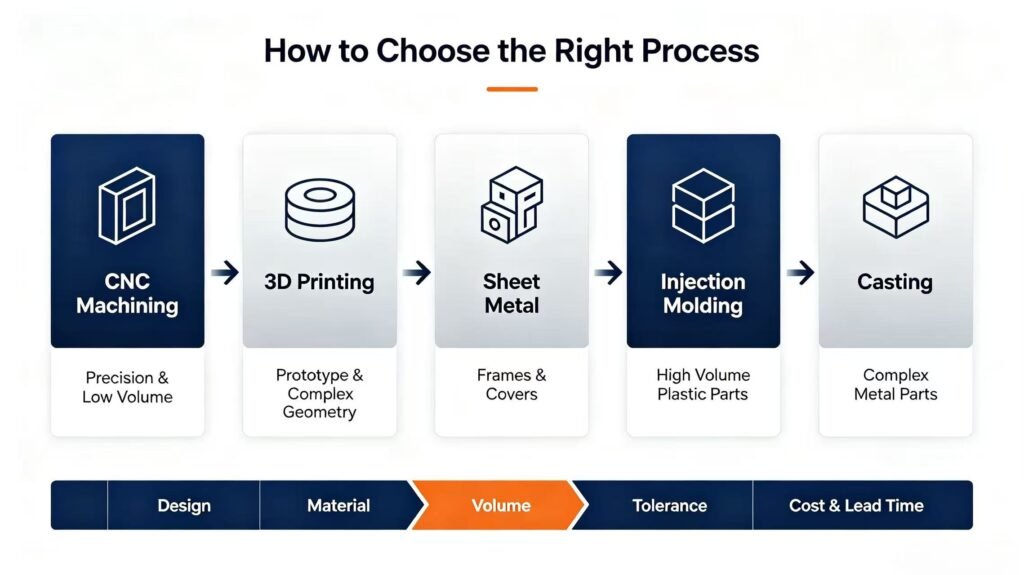
Consider these key factors:
Part design: Complex geometries may require CNC machining or 3D printing.
Material: Choose a material based on strength, weight, wear resistance, and operating conditions.
Production volume: 3D printing and CNC machining are suitable for prototypes and smallerquantities, while injection molding and casting can be considered for larger production runs.
Tolerance: Tight tolerances and precision mating surfaces often require CNC machining.
Cost and delivery time: The right process should balance quality, production cost, and lead
time.
Custom Robot Components from Drawings
Every robotics project has different requirements. A professional manufacturer can produce custom robotic parts based on 2D drawings, 3D CAD files, samples, or technicalspecifications.
With capabilities including CNC machining. sheet metal fabrication, 3D printing. injection molding, and casting, different manufacturing solutions can be selected according to the actual requirements of each component.
FAQ
What is the best process for robot components?
There is no single best process. CNC machining, 3D printing, sheet metal fabrication, injection molding, and casting are suitable for different applications.
Is CNC machining suitable for robotic arm parts?
Yes. CNC machining is suitable for robotic arm components that require high precision, repeatability, and reliable mechanical performance.
Can you manufacture robot parts from drawings?
Yes. Custom robot components can be manufactured according to 2D drawings or 3D CAD files.
Conclusion
Choosing the right robot components manufacturing process can improve part quality,reduce unnecessary costs, and shorten production time.
Whether you need precision CNC robot parts, sheet metal components, 3D printed prototypes,injection molded plastic parts, or cast components, selecting the right process is the key tosuccessful production.
Have a robot component to manufacture? Send us your 2D drawing or 3D CAD file for a quotation.